
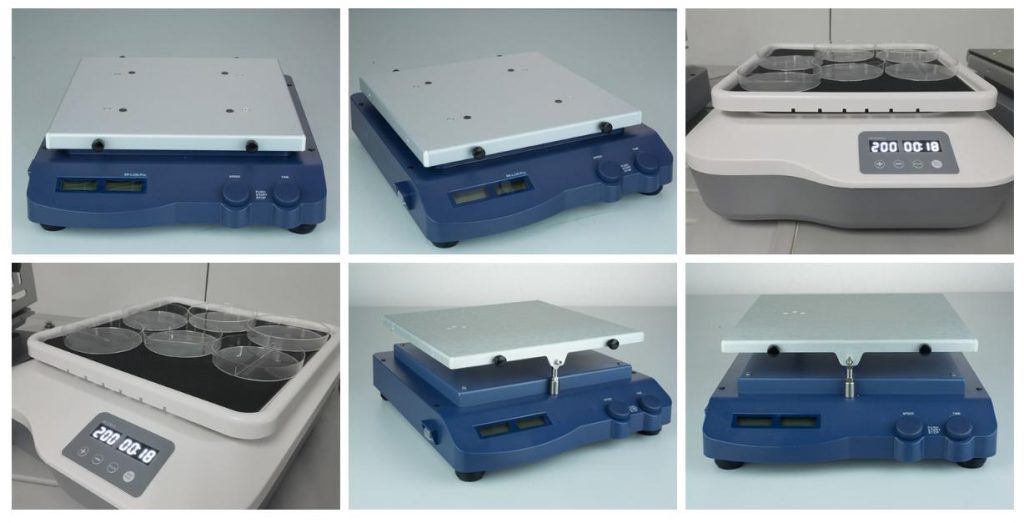
Most laboratory equipment gets credit for doing one thing extremely well. The lab shaker is that rare instrument that does several things well simultaneously and quietly earns a place on almost every serious bench. Bacterial culture, protein expression, ELISA plate incubation, gel staining, blotting, dissolution testing, nucleic acid hybridization: all of these workflows require agitation, and each one requires a different type of agitation. Understanding what distinguishes shaker types is the starting point for using them correctly and choosing the right model when it comes time to buy.
This guide covers every major lab shaker type, the motion it produces, the applications it best serves, and the practical specifications that determine whether a given model fits your workflow. No filler, no vague generalities. Just the information you actually need to match instrument to application.
Orbital Shakers: The Versatile Workhorse
The orbital shaker moves its platform in a smooth, horizontal circular path. That circular motion creates a gentle swirling pattern in the liquid inside any flask or tube placed on the platform, simultaneously mixing the contents and, for open or vented vessels, increasing gas exchange at the liquid surface. This oxygen transfer effect is why orbital shakers dominate aerobic biological culture applications: the swirling motion keeps dissolved oxygen above limiting concentrations in a way that static incubation cannot.
For bacterial suspension culture, the standard orbital shaker speed is 200 to 250 RPM, as published in Fisher Scientific’s shaker selection documentation. For mammalian cell suspension culture, where shear sensitivity limits how aggressively you can mix, speed drops to 30 to 100 RPM. For ELISA plate incubation and gel staining, low speeds of 50 to 100 RPM and 15 to 70 RPM respectively provide coverage without turbulence. That breadth of application from a single lab shaker type makes the orbital model the first instrument most labs acquire and the one that sees the most continuous use.
Reciprocating (Linear) Shakers: For High-Agitation Applications
Reciprocating shakers move the platform back and forth in a straight line. The directional, more aggressive motion is suited to applications where vigorous agitation is needed rather than gentle circulation: dissolution testing of pharmaceutical tablets and capsules, solvent extraction from solid matrices, and physical mixing protocols that require more force than orbital motion provides.
In pharmaceutical quality control, dissolution testers use reciprocating motion specifically because it replicates the mechanical action in the gastrointestinal tract more closely than orbital circulation does. This is an application where the motion type is part of the validated test method, not simply a preference.
Rocking Shakers: For Flat Surfaces And Membranes
Rocking shakers tilt alternately up and down like a seesaw, creating a wave in the liquid covering the platform. This wave sweeps gently back and forth across any flat surface placed on the platform, providing even coverage without the turbulence that orbital motion would produce.
Western blot workflows are the paradigm application. The antibody incubation, blocking, and wash steps all require that the solution makes uniform contact with the nitrocellulose or PVDF membrane without damaging it. Rocking motion delivers this; orbital motion at equivalent speeds does not. Gel staining, destaining, and Southern blot hybridization applications use rocking shakers for the same reason: the goal is surface coverage and uniform reagent contact, not suspension or oxygenation. A lab shaker with rocking motion is not interchangeable with an orbital model for these applications, and treating them as equivalent is how patchy Western blot signal happens.
Incubator Shakers: Temperature-Controlled Culture
Incubator shakers combine orbital or reciprocating motion with an enclosed, temperature-controlled chamber. They are the appropriate choice when both agitation and temperature control are required simultaneously: bacterial culture at 37 degrees Celsius, protein expression at reduced temperatures of 16 to 25 degrees Celsius for improved solubility, yeast culture at 30 degrees, and any other protocol where maintaining a defined temperature throughout the shaking period is part of the experimental design.
The engineering distinction between an incubator shaker and a standard orbital shaker placed inside an incubator is meaningful. Incubator shakers are designed for the thermal environment: their motors and electronics are rated for the elevated temperature and humidity of an enclosed chamber. Standard orbital shakers often are not, and operating them inside an incubator can shorten their service life significantly.
Key Features To Evaluate Before Buying
Speed range and digital control: Digital orbital shakers with closed-loop speed control maintain the programmed RPM regardless of load variation, ambient temperature, or motor wear. The displayed speed is the actual speed, not an estimate from a dial position. For any application where speed is a controlled experimental variable, digital control is a requirement, not a preference.
Orbital diameter: The diameter of the circular path the platform traces at a given RPM affects how vigorous the mixing is. Standard laboratory orbital shakers use 19 to 25 mm orbits. Larger-orbit shakers provide more vigorous mixing at the same RPM. The orbital diameter is a fixed hardware specification for each model and must be matched to your application requirements at the time of purchase.
Platform size and load capacity: Platform size determines how many flasks or plates you can run simultaneously. Load capacity determines how much total mass the motor can handle reliably. Both specifications must be checked against your typical experimental batch size.
Timer function: A programmable timer allows unattended timed runs that stop automatically at protocol completion. This creates consistent protocol endpoints and eliminates the over-incubation that occurs when operators are occupied with other tasks at run completion time.
The Bottom Line On Lab Shakers
The right lab shaker for your workflow is determined by the motion type your application requires, the speed range your protocols specify, and the temperature control needs of your work. Matching these three criteria to the instrument before purchase prevents the performance problems that come from using the wrong type of agitation for the sample and application at hand.
Trusted lab suppliers like NE LabSystem scarry the full range of orbital, rocking, and incubated shakers backed by free extended warranties on U.S. purchases and factory-trained engineering support.